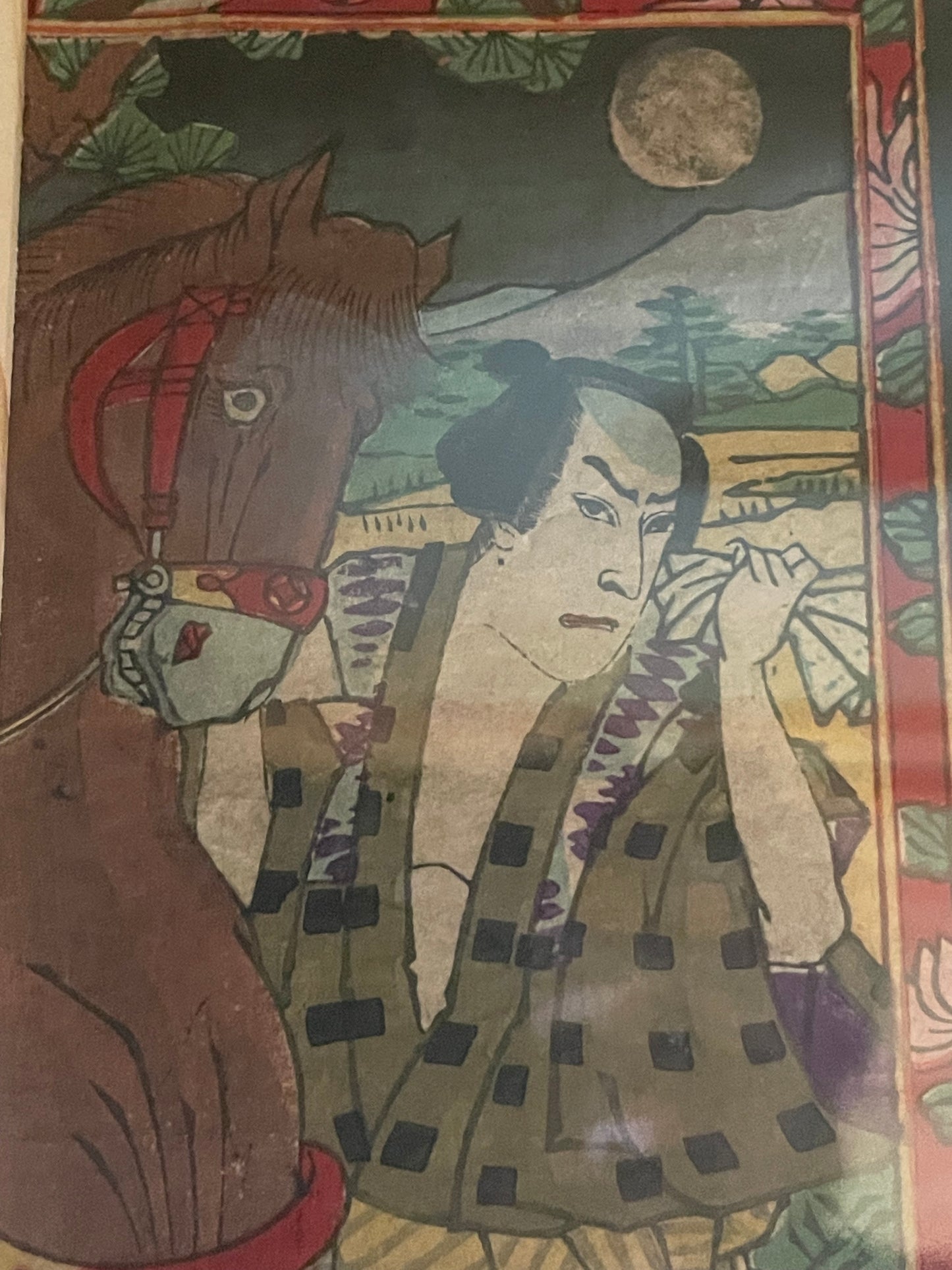
Very good condition overall. There are no insect holes, stains, or tears. The surviving cover page has been preserved in a postcard-sized frame and displays beautifully.
This original Meiji-period woodblock-printed book cover comes from Ehon Shiobara Tasuke (絵本塩原多助), published in 1890 (Meiji 23) by Hōeidō under the publisher Ozeki Toyo.
The remainder of the book was damaged beyond repair and no longer survives. Fortunately, the cover page was salvaged and preserved separately, allowing this attractive example of Meiji-period book illustration to survive as a standalone artwork.
The illustration depicts one of the most famous scenes from the story of Shiobara Tasuke, the beloved episode known as Aiba no Wakare ("Parting from the Beloved Horse"). The scene shows Tasuke standing beneath a crescent moon as he bids farewell to his faithful horse, Ao, in a deeply emotional moment that became famous throughout Japan.
The story of Shiobara Tasuke originated as a popular narrative by the renowned rakugo storyteller Sanyūtei Enchō and became one of the most celebrated human-interest tales of the Meiji era. Its themes of perseverance, loyalty, hardship, and compassion resonated strongly with audiences, leading to countless adaptations in books, theater, and popular entertainment.
As a book cover intended for the mass market, the design reflects the bold and accessible illustration style that characterized late nineteenth-century Japanese publishing. Such covers were created to attract readers with dramatic scenes and recognizable characters, making them an important part of Japan's rapidly expanding print culture during the Meiji period.
Today, surviving cover pages are often rarer than the books themselves, as they were particularly susceptible to wear and damage through everyday use. In this case, the cover is the sole surviving portion of the original publication, preserving both the artwork and a small piece of Meiji-era popular culture.
A charming example of Meiji-period publishing history, suitable for collectors of Japanese literature, rakugo history, and woodblock-printed book illustrations.