Taxes included.
Near perfect antique condition. No stains were noticed upon inspection, and there is no significant discoloration or major holes. Some minor fraying is present along the outer edges of the individual sheets, consistent with age. The colors remain exceptionally vivid and the woodblock lines sharp and clearly defined. Measures approximately 75 × 38 cm.
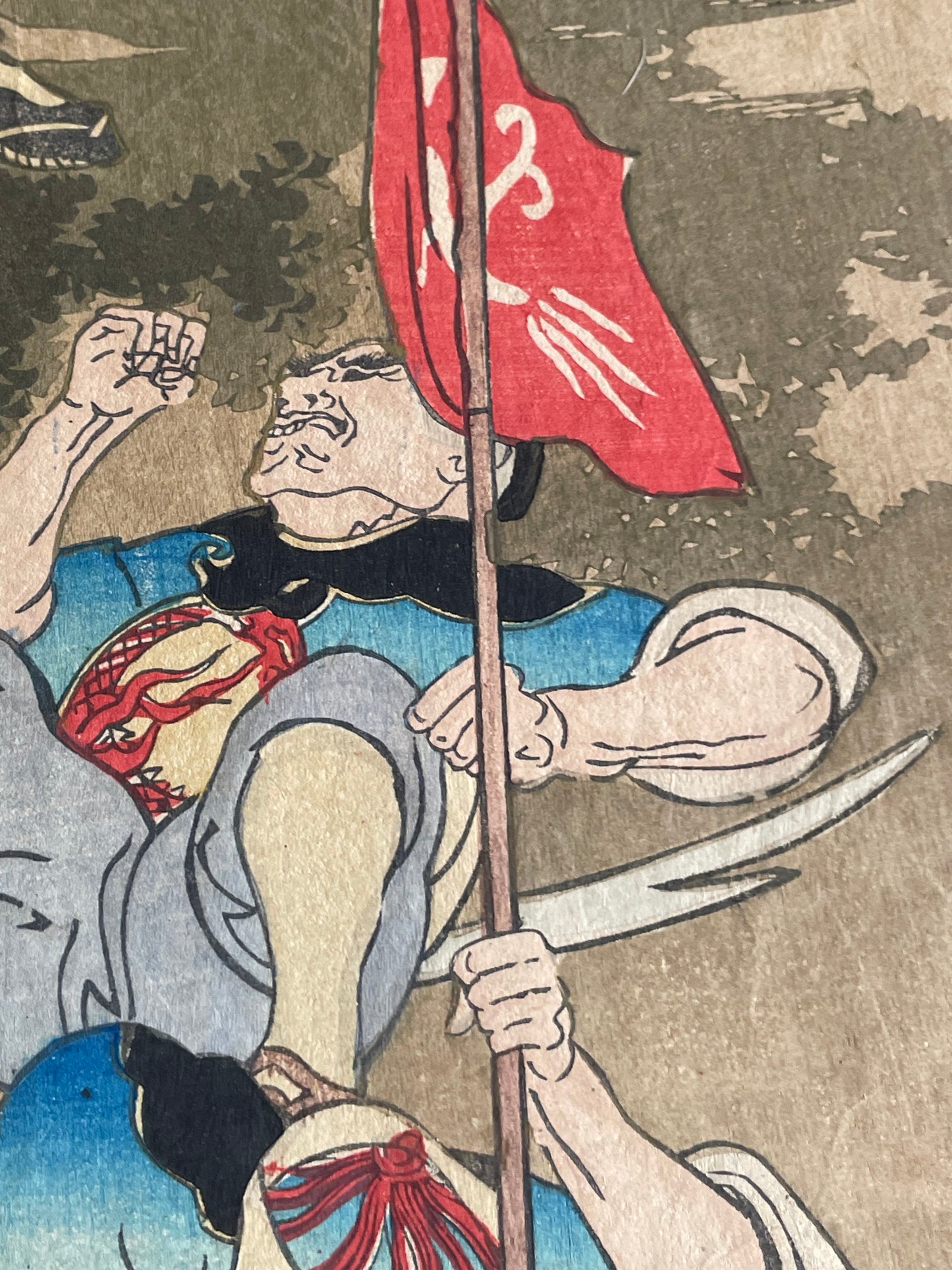
This original 1898 (Meiji 31) nishiki-e woodblock triptych by Utagawa Kokunimasa (歌川国政, 1874–1944) is titled Japanese Army Fierce Battle at Jiuliancheng — 日本大捷 九連城激戦之図 (Nihon Taishō Kyūrenjō Gekisen no Zu). Published in Tokyo by Fukushima Gisaburō (福島儀三郎), it depicts a dramatic episode from the First Sino-Japanese War (1894–1895).
Across the three-sheet panoramic composition, Japanese infantry charge Chinese forces amid dense clouds of battlefield smoke. Rifles, fixed bayonets, artillery, and hand-to-hand fighting fill the scene, while the commanding Japanese officer is identified by the cartouche as Major General Nozu (野津中将).
The print belongs to the Meiji tradition of sensō-e (戦争絵), or war prints. These dramatic multicolor woodblock prints documented and celebrated Japan's military campaigns for a domestic audience, combining contemporary events with the dynamic compositions and vivid colors of traditional ukiyo-e.
An especially interesting feature is the date. Although the battle depicted occurred during the 1894–1895 Sino-Japanese War, the publication information explicitly dates this impression to Meiji 31 (1898), several years after the conflict ended.
Hand-carved and hand-printed on traditional Japanese paper, the triptych retains the brilliant colors and energetic linework characteristic of late Meiji nishiki-e and provides a striking visual record of how Japan's military victories were represented in popular art during the period.