Taxes included.
Near perfect vintage condition. The scroll exhibits minimal creasing from careful storage, with no holes, stains, or significant signs of wear. The painting remains exceptionally clean and well preserved. Measures approximately 150 × 41 cm.
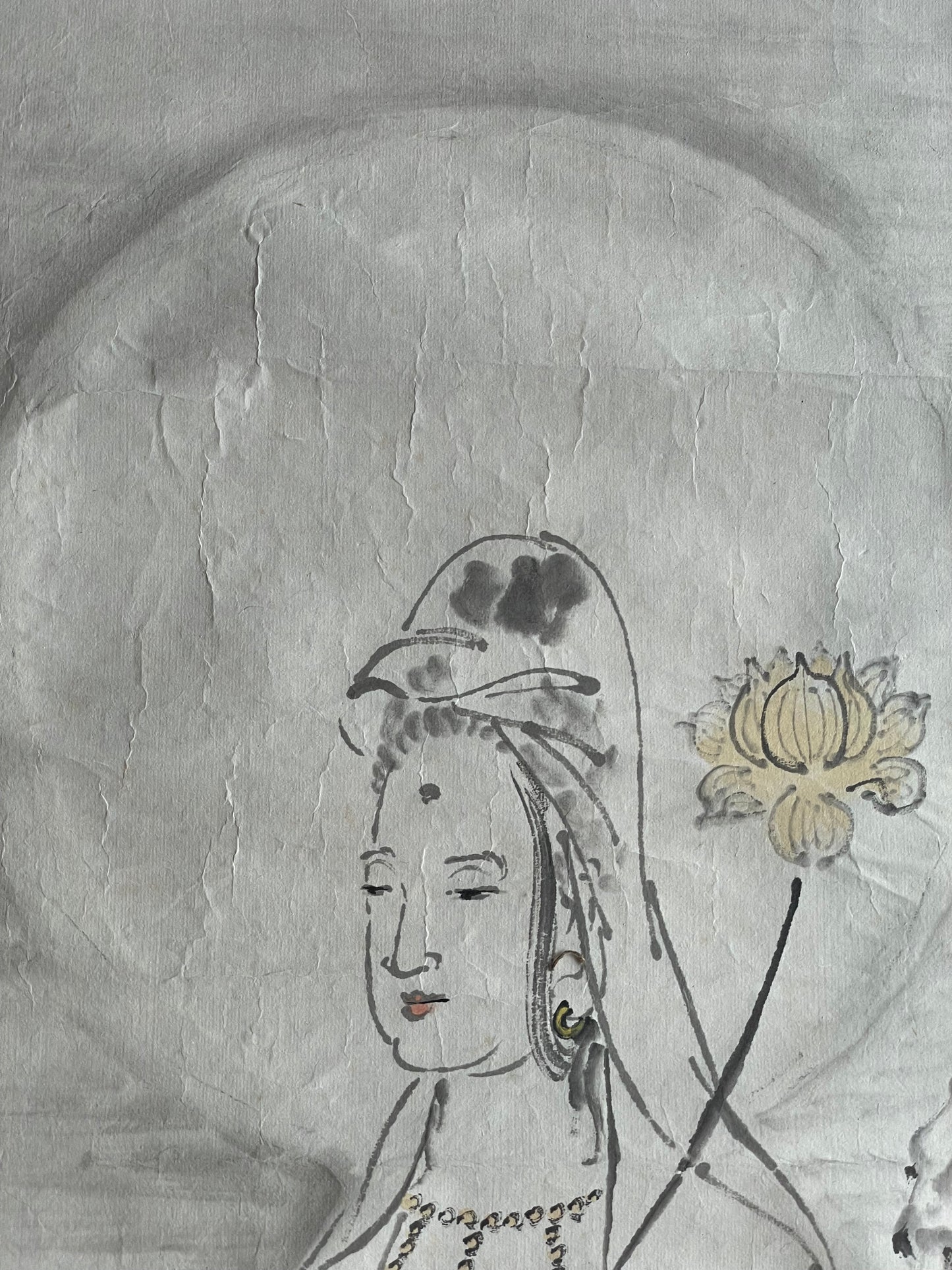
This original hand-painted hanging scroll, created between approximately 1920 and 1950, depicts Byakue Kannon (白衣観音), the White-Robed manifestation of Kannon Bosatsu, the Bodhisattva of Compassion. Signed 兼望 (Kanemochi) with the artist's seal, the work is consistent with paintings by the same artist known from signed works produced in Keijō (Seoul) during the first half of the twentieth century.
Kannon is shown seated peacefully upon a rocky outcrop overlooking calm waters, holding a graceful lotus stem. The luminous halo, flowing white robes, and lotus are the traditional attributes of Byakue Kannon, one of the most revered forms of Avalokiteśvara in East Asian Buddhism. The restrained palette and elegant brushwork create a quiet, contemplative atmosphere that reflects the ideals of Buddhist devotional painting.
During the Japanese colonial period, Keijō was an important artistic center where painters produced Buddhist hanging scrolls and literati-style ink paintings for temples, private residences, and tokonoma alcoves. White-Robed Kannon remained a particularly popular subject throughout the early Shōwa period, valued both for its artistic beauty and its spiritual significance.
In Buddhist tradition, Byakue Kannon symbolizes compassion, mercy, healing, protection, and safe childbirth. Hanging a White-Robed Kannon scroll in the home was traditionally believed to bring peace, spiritual comfort, and blessings upon the household, making works of this type both devotional objects and refined works of art.
A beautifully preserved early twentieth-century Buddhist hanging scroll by Kanemochi, combining elegant traditional brushwork with one of the most enduring and beloved subjects in Japanese religious painting.