Taxes included.
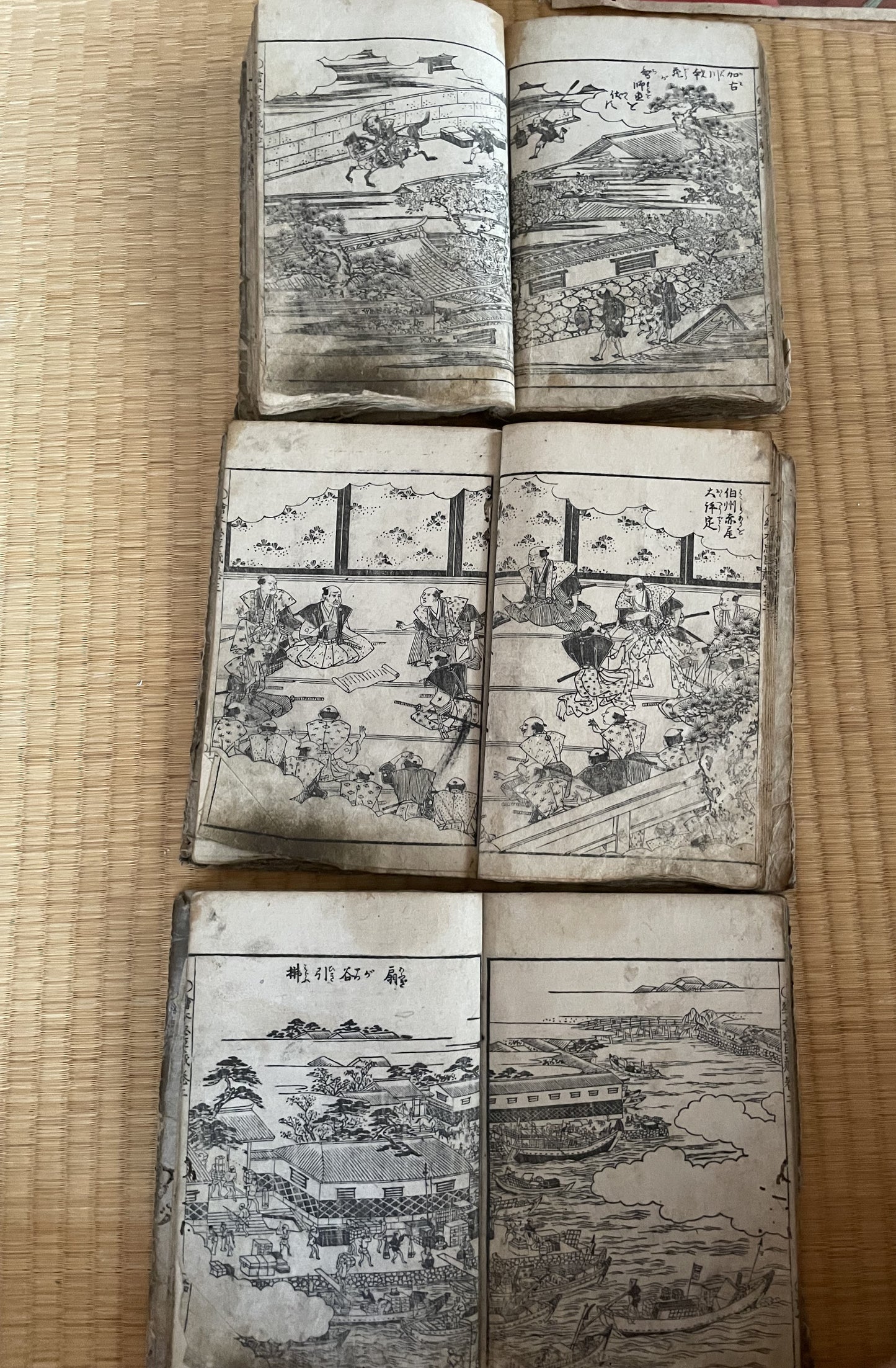
Good antique condition considering these three books were printed more than 215 years ago. There is some insect and water damage, including wear around portions of the pages and edges. Despite this age-related deterioration, the woodblock illustrations remain in good condition overall, with strong black ink and clearly defined linework. The images retain considerable detail and remain visually impressive. Upon inspection, there do not appear to be any missing pages. All three original books are included together as one set.
Dating to 1808 (Bunka 5), this set of three original Edo-period woodblock-printed books is from Ehon Chūshingura (絵本忠臣蔵), or Illustrated Treasury of Loyal Retainers. The work presents an extensively illustrated version of the famous Forty-Seven Rōnin / Akō vendetta, with illustrations by Katsushika Hokusai (葛飾北斎) and text by Takizawa Bakin (滝沢馬琴 / 曲亭馬琴).
The three books contain numerous detailed woodblock illustrations depicting samurai, court officials, residences, gardens, ceremonies, confrontations, and other important episodes from the Chūshingura narrative. Many of the illustrations occupy entire pages or two-page spreads, creating elaborate scenes filled with architecture, costumes, weapons, landscapes, and finely carved decorative details.
Among the identifiable figures is Enya Hangan Takasada (塩谷判官高貞), the fictionalized counterpart of the historical Asano Naganori. Kō no Moronao (高師直) represents Kira Yoshinaka, whose conflict with Asano ultimately led to the famous Akō vendetta. The contents also reference Enya Hangan's seppuku, the pivotal event that sets the revenge of his loyal retainers in motion.
The historical Akō Incident of 1701–1703 became one of Japan's most celebrated stories of loyalty, honor, and samurai revenge. In Chūshingura, the events were transferred to an earlier historical setting and the principal participants were given fictionalized names.
Printed from hand-carved wooden blocks in sumi ink on traditional Japanese paper, these books demonstrate the sophisticated craftsmanship of early nineteenth-century Japanese publishing. The extensive illustrations make the set particularly visually engaging and preserve an extraordinary amount of detail despite more than two centuries of age.
Offered together as a three-book set, these surviving 1808 volumes combine one of Japan's most enduring samurai narratives with the work of two major figures of Edo-period culture.