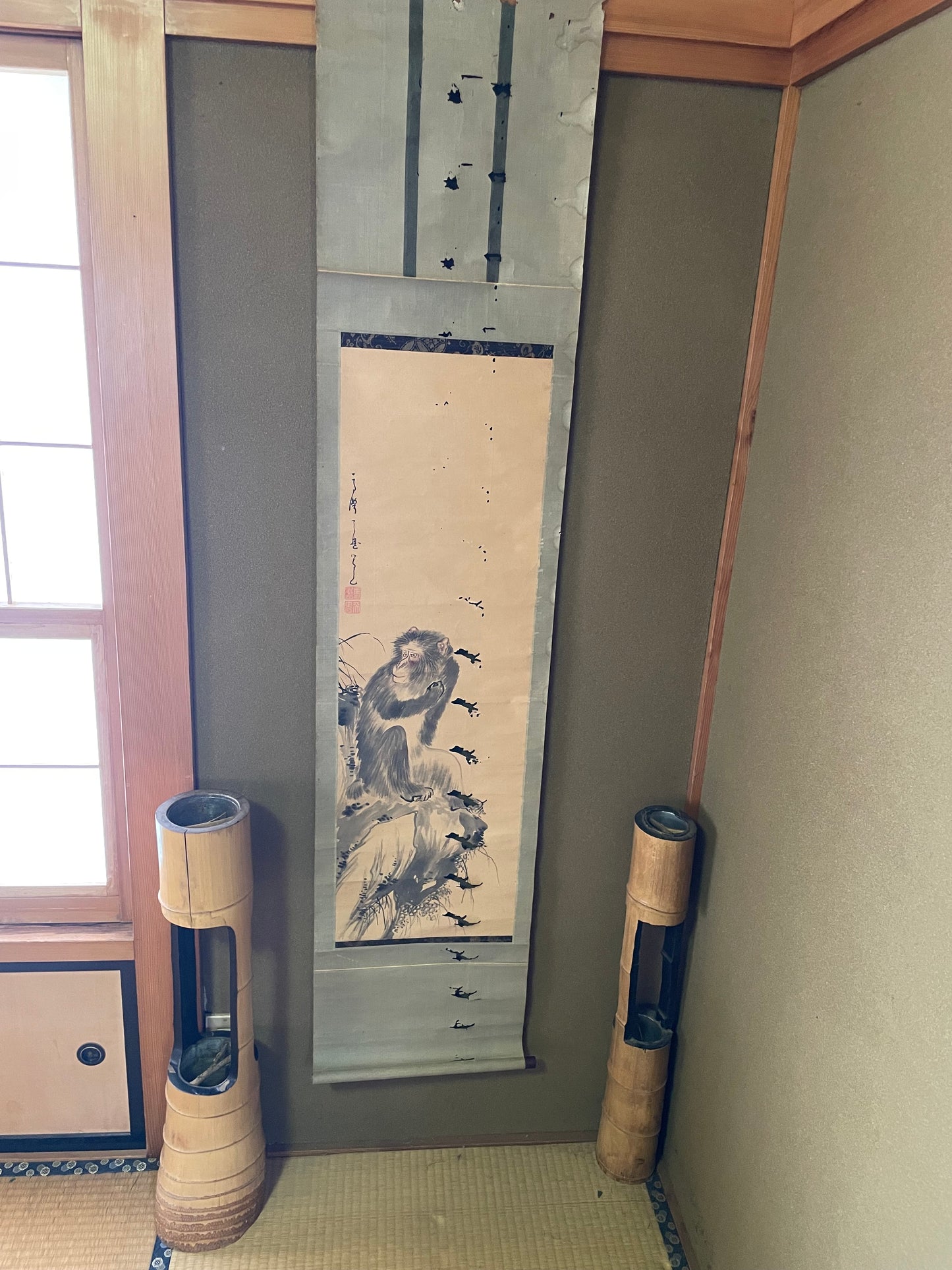
AntiqueJapanese hanging scroll painting of a monkey, signedKawabata Gyokushō (川端玉章). Gyokushō lived1842–1913and was one of the important painters of the late Edo to early Meiji period. He was active primarily in thelate 19th century, especially from the1870s through the 1890s, and became well known for his refined ink painting and naturalistic subjects.
Gyokushō studied within theMaruyama–Shijō painting tradition, which emphasized observation of nature and expressive yet controlled brushwork. His work often depicted animals, plants, and seasonal scenes with careful attention to movement and character.
The scroll measures approximately164 cm x 37 cm, a tall vertical format typical of decorativetokonoma display scrollsused in traditional Japanese interiors.
Monkeys have long held symbolic meaning in Japanese art and folklore, often associated withintelligence, wit, and spiritual protection. In painting they are frequently rendered with lively brushwork that captures both personality and motion. In this work, the artist uses fluid ink strokes and tonal variation to give the animal a sense of life and immediacy.
Large scroll paintings from theEdo–Meiji transitional periodare increasingly scarce, particularly examples by identified artists such as Kawabata Gyokushō. The piece represents both a decorative work of traditional Japanese painting and a historical example of late 19th-century artistic practice.