Taxes included.
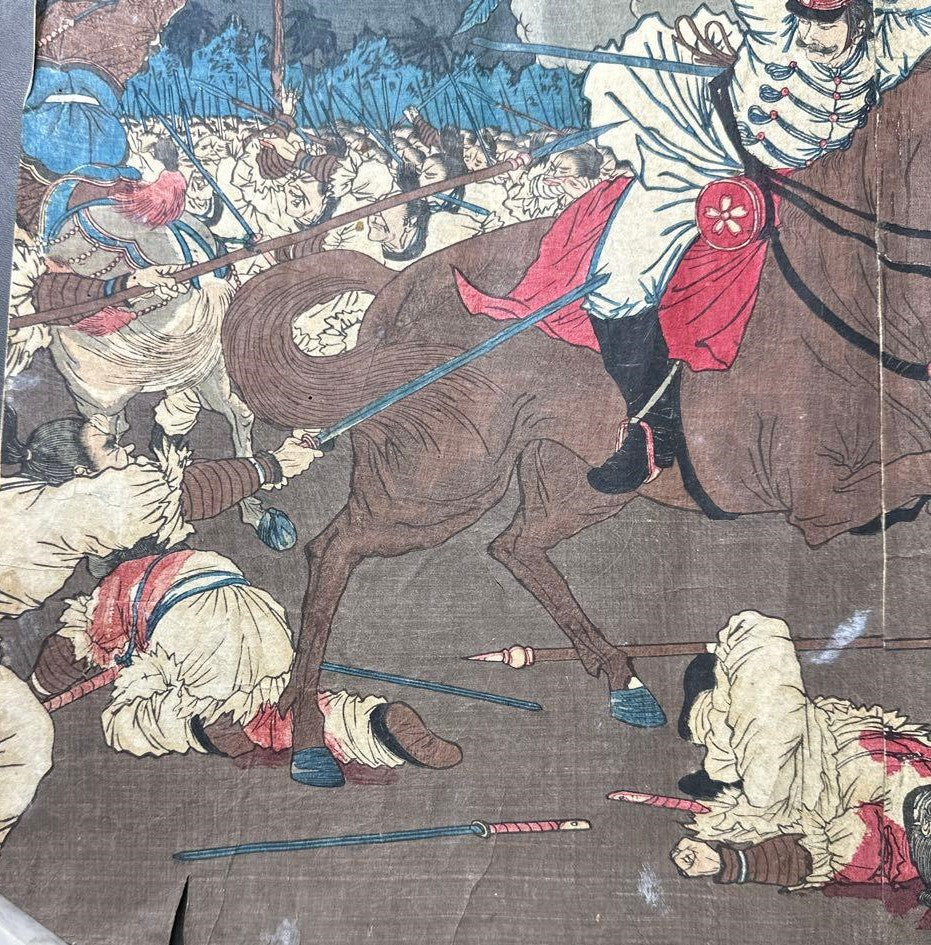
This original 1882 (Meiji 15) color woodblock triptych is titled Chōsen Henpō (朝鮮変報), meaning News from Korea. It depicts the Imo Incident (壬午事変), the violent uprising in Seoul that resulted in an attack on the Japanese legation and became a major diplomatic crisis between Japan and Korea.
At the center of the composition is Hanabusa Yoshitada (花房義質), Japan's minister to Korea, shown mounted on horseback amid the fighting. Additional Japanese participants are individually identified by cartouches throughout the three sheets as they confront Korean soldiers and rioters.
The Imo Incident erupted in July 1882, when dissatisfied soldiers of the Joseon army mutinied in Seoul. The unrest developed into a broader anti-government and anti-Japanese uprising, during which the Japanese legation was attacked. Hanabusa and surviving members of the legation were forced to flee Seoul.
The enormous heading 朝鮮変報, literally News from Korea or Special Report from Korea, emphasizes the print's function as a form of illustrated contemporary news. Before photography could be rapidly reproduced in Japanese newspapers, colorful nishiki-e allowed publishers to bring dramatic representations of major political and military events to the public.
Printed as a three-sheet panoramic composition, the work combines traditional ukiyo-e woodblock techniques with a contemporary international event, making it an important example of the topical news prints produced during the early Meiji period.
Beyond its dramatic imagery, the triptych documents an important moment in nineteenth-century relations between Meiji Japan and Joseon Korea, only fourteen years after the Meiji Restoration and during a period of rapidly increasing Japanese involvement on the Korean Peninsula.