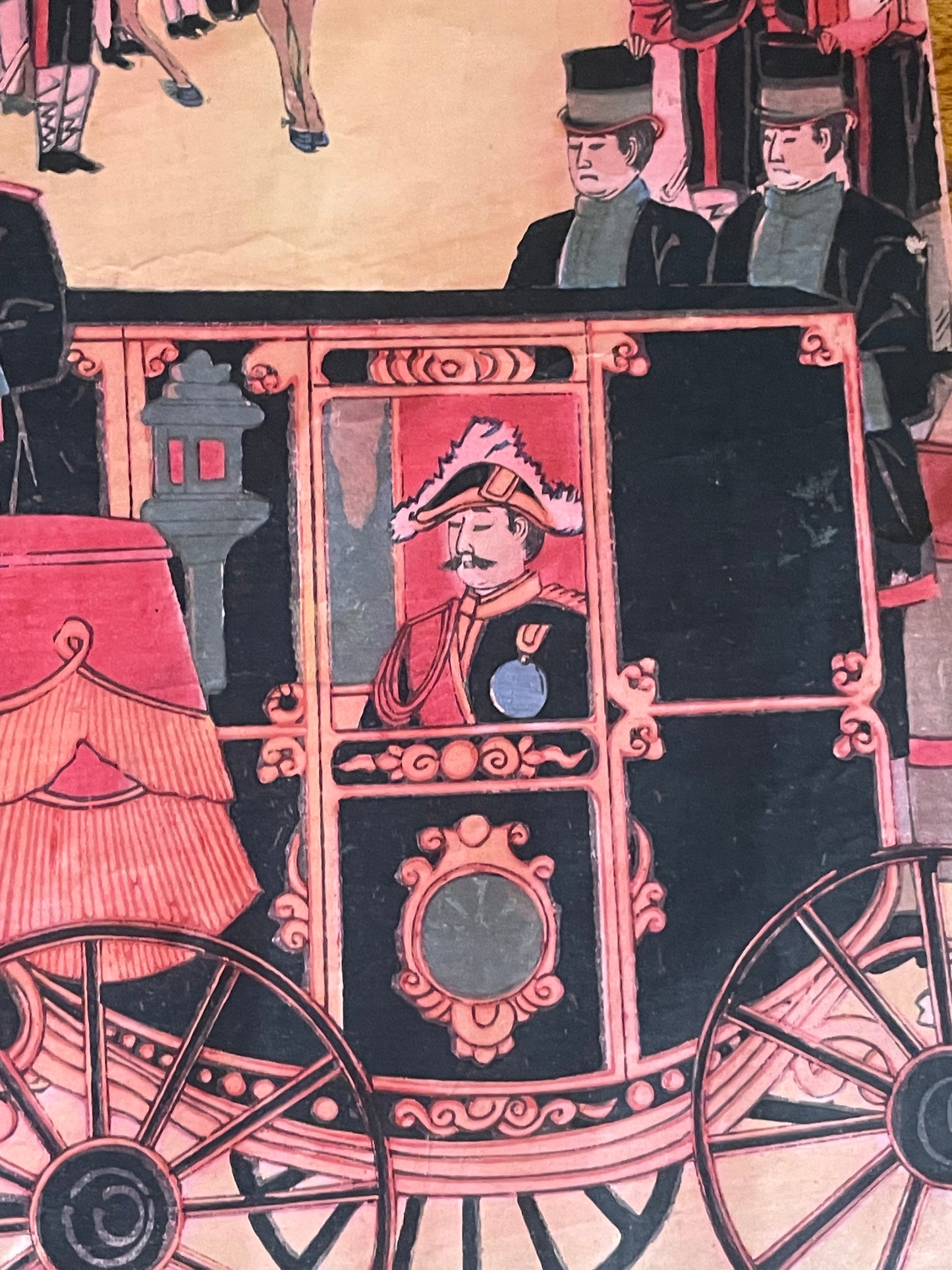
Meiji 1894 Ukiyo-e Nijūbashi Imperial Phoenix Carriage Procession by Utagawa Kunitoshi (Approximately 38X75CM)
Meiji 1894 Ukiyo-e Nijūbashi Imperial Phoenix Carriage Procession by Utagawa Kunitoshi (Approximately 38X75CM)
Good antique condition overall. A backing was added at some point in the past, joining the three individual sheets into a single composition. The primary damage consists of two holes, while the majority of the image remains in good condition. The colors remain exceptionally vivid and the woodblock lines are still sharp and clearly defined. There is slight bleeding of the ink in some areas, but this is only noticeable upon close inspection. Measures approximately 75 × 38 cm.
This original Meiji-period nishiki-e woodblock triptych by Utagawa Kunitoshi (歌川国利) is titled Nijūbashi Imperial Phoenix Carriage Procession (二重橋御鳳輦之図 / Nijūbashi Gohōren no Zu). The composition is associated with the imperial procession imagery produced around the 1894 (Meiji 27) Silver Wedding celebrations of Emperor Meiji and Empress Shōken.
The panoramic scene depicts Emperor Meiji and Empress Shōken traveling in the Imperial carriage during a magnificent formal procession at Nijūbashi, outside the Imperial Palace in Tokyo. The carriage dominates the center of the composition, surrounded by mounted guards, cavalry, and orderly ranks of soldiers. The Imperial Palace grounds and Nijūbashi provide the setting, while Mount Fuji rises prominently in the distance.
Kunitoshi produced several works depicting the ceremonies and public appearances of the Imperial family. A closely related documented composition, Ginkon Taiten Nijūbashi Goshutsumon (銀婚大典二重橋御出門), records the Imperial couple departing through Nijūbashi during celebrations marking their 25th wedding anniversary in 1894.
Imperial processions became an important subject of Meiji-period modernization prints, combining the traditional techniques of ukiyo-e with imagery of Japan's rapidly changing society. Western-style military uniforms, cavalry formations, ceremonial carriages, and the modern Imperial state appear alongside the established visual language of Japanese woodblock printing.
The brilliant reds and other saturated colors are characteristic of later nineteenth-century nishiki-e, when imported synthetic pigments allowed Meiji artists to create exceptionally bold and colorful compositions.
Couldn't load pickup availability
Low stock: 1 left
View full details